Breed Standard
REPRODUCED FROM THE RMHA WEBSITE WITH PERMISSION
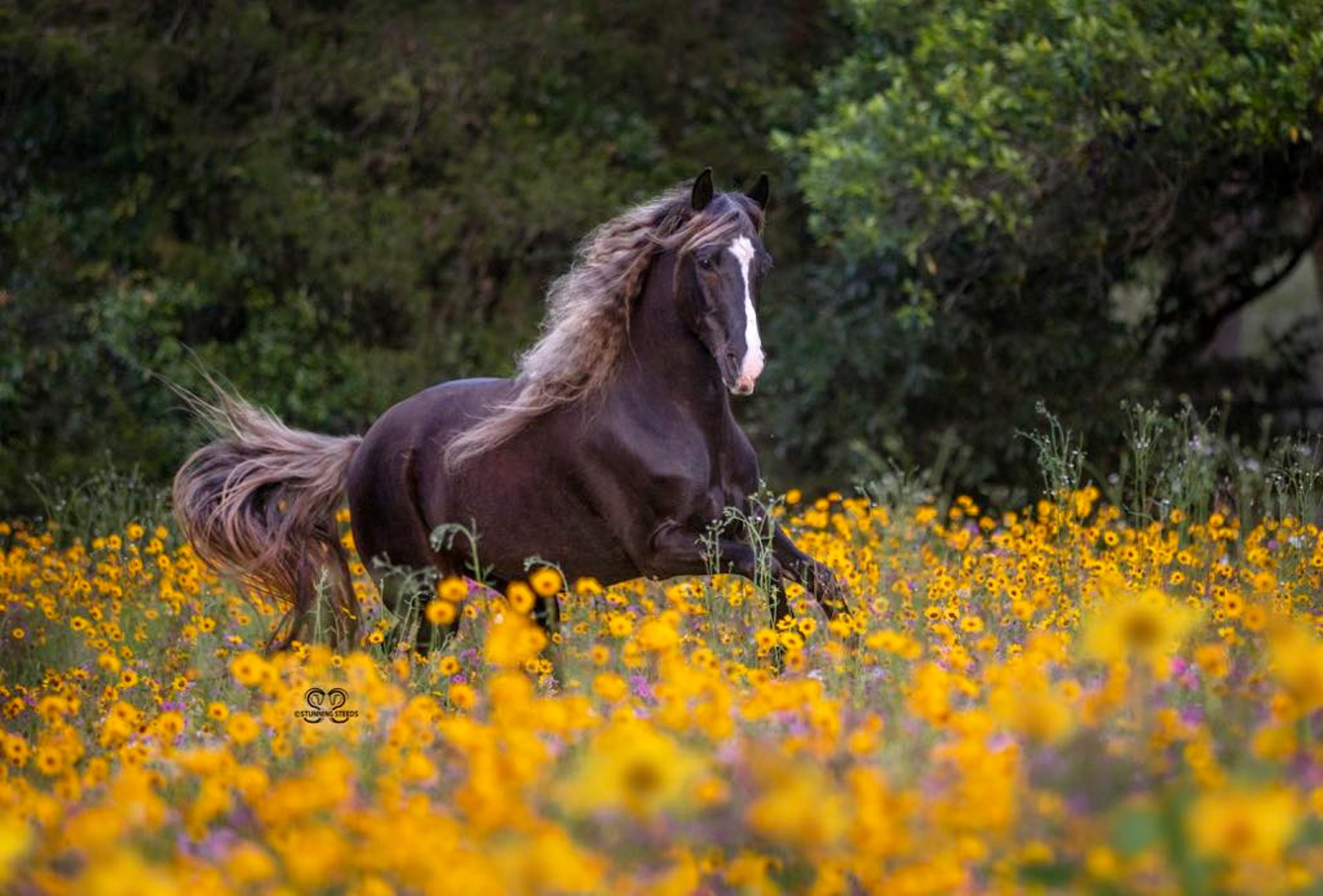
The United States Patent and Trademark Office defines the Rocky Mountain Horse® as “a Horse having a medium height, a broad chest, an ambling four-beat gait, a gentle temperament and a solid body color.” All Rocky Mountain Horses will demonstrate the gait, conformation and gentle temperament as stated in the Bylaws of the Rocky Mountain Horse®Association, Inc.
GAIT
The Rocky Mountain Horse® naturally demonstrates a smooth ambling gait that glides forward. The horse moves out with a lateral gait in which one can count four distinct hoof-beats that produce a cadence of near equal rhythm. The speed may vary but the four beat rhythm remains constant. The gait may technically be described as the simultaneous but asynchronous motion of the legs on the same side of the body followed by the movement of the legs on the opposite side. The gait is initiated with the hind leg. The length of stride for both hind and foreleg should be nearly equal. The Rocky Mountain Horse moves his feet with minimal ground clearance and minimal knee and hock action. Because the gait does not waste motion, it enables the horse to travel long distance with minimal tiring.
CONFORMATION
The height of the Rocky Mountain Horse will be no less than 56 inches (14 hands) and no more than 64 inches (16.0 hands). Medium sized bones, with medium sized feet in proportion to the body. A wide and deep chest with a span between the forelegs. The fore and hind legs should be free of noticeable deformity. Sloping shoulders (ideally with an angle of 45 degrees). Bold eyes, well-shaped ears and a face that is neither dished nor protruding. The head should be of medium size in proportion to the body with medium jaws. The neck should be gracefully arched, medium in length and set on an angle to allow natural carriage with a break at the poll. The horse must have a solid body color. There shall be no white above the knee or hock except on the face where modest amounts of white markings are acceptable. Excessive facial markings such as a “bald faced” horse are not acceptable.
THE IMPORTANCE OF TYPE IN THE ROCKY MOUNTAIN HORSE
D. PHILLIP SPONENBERG, DVM, PHD
“Type” is a difficult concept to define, but is an absolutely vital one when talking about breeds of livestock. One definition of type is the conformational peculiarities that separate one breed from another. It is safe to add that “type” almost represents the ideal mental picture of a breed. Type is therefore central to a breed’s character and identity, and it is what sets the different breeds apart one from another. Quarter Horses have a “type”, and Spanish Mustangs a different “type”. Even closely related breeds, such as the Peruvian Paso and the Spanish Mustang, have subtle differences in type that help distinguish one from the other. Likewise, Rocky Mountain Horses are a different type that Saddlebreds and Tennessee Walking Horses, but only subtly different from the closely related Mountain Pleasure Horse.
The Rocky Mountain Horse comes to us today as an interesting amalgam of a few different strains and sources of founder horses. One result of the base upon which the breed is founded is that there are at least subtly different types within the Rocky Mountain breed. Even at the extremes within the breed there are some consistent conformational traits that set Rocky Mountain Horses off from other horses, and these conformational traits are essential to the typiness of the breed. Horses that exhibit all of the conformational peculiarities of the breed are said to be “typier” than those that have fewer.
Breeders of any breed need to be aware of type and what it is. Within every breed some individuals are going to be born that are “off type”. The fate of these individuals has an important impact on the fate of the breed. If these animals are heralded and used widely as breeding stock, the breed’s type will slowly erode until the original breed is unrecognizable. If, on the other hand, “off type” individuals are culled from breeding, then the original type can be preserved.
Modern horse breeds in America can give good lessons in the importance of type, and the ability of breeders to change type. One example is the Morgan horse. The original Morgan was a dual-purpose farm chunk, valued for its durability and for its strength. Fashion has changed some strains of Morgan away from the original model into more of a refined show horse. Some of this was done by crossbreeding, but much of it was done by selecting away from the original type. This has been done to the extent that the original type is now quite rare, and its breeders concerned about its extinction.
Draft breeds, such as the American Belgian and Clydesdale, are other good examples of the ability of type to change. Originally these were massive, stocky heavy horses with great bulk. They were used for agricultural work. The modern use for these is usually for parade use, and this has favored a much leggier, refined type. The original type is rare. So which one is the “real” breed – the modern type or the original? This is an important question in breed conservation, and has no easy answer.
Type in beef cattle breeds has seen even larger changes than has that in horse breeds – and swine probably have changed type the most of any species of livestock. All of this has helped the breeds in question to adapt to current demands, although in the process the result has been that all breeds tend to start looking very alike. Without the distinctiveness of breeds there is less chance for any breed to really fit a specialized niche, as they all become generalists.
Breeders of Rocky Mountain Horses need to ponder the importance of type to the breed. If type is important, then it needs to become the responsibility of every breeder to breed toward the breed type. This is especially important in the Rocky Mountain Horse which sits between the Spanish horses and the other North American gaited breeds. If the Rocky Mountain Horse becomes nothing more than another Spanish breed, or at the other extreme, another Saddle Horse, then what is the value in having it as a distinct breed? My own bias is to conserve the Rocky Mountain Horse as a unique genetic resource – and this means that its type should be different than other breeds. The historic type of Rocky Mountain Horse has been very successful – it does not need to be changed.
D.Phillip Sponenberg, DVM, PhD
Professor, Pathology and Genetics
Virginia-Maryland Regional College of Veterinary Medicine
Virginia Tech
Blacksburg, VA 24061
USA
The Transatlantic Rocky Mountain Horse Club
Promoting the Rocky Mountain Horse®
across Europe.
© 2025. All rights reserved.
Designed by clarity@2am